I Approved a Grundfos Water Pump Order Without Opening the Dimension Drawing. It Cost Us $4,800.
2026-09-15 · Rebecca Sloan
-
The Phone Rang at 6:40 on a Tuesday in April 2025
-
How the Order Came In
-
The Pump: The Drawing I Never Opened
-
The Filters: Cheapest Unit Price, Most Expensive Order
-
The Spark Plugs: One Small Letter, One Big Problem
-
The Bill: $4,800 and a Lost Renewal
-
What We Changed
-
If You're Getting Ready to Place an Order
The Phone Rang at 6:40 on a Tuesday in April 2025
I was putting on my shoes when the call came in. It was the plant manager at one of our maintenance customers. In the background I could hear metal hitting concrete — that specific sound you never want to hear on a work phone.
"The pump won't bolt on," he said. "The flange pattern doesn't match. We've been at this for two hours."
Two hours. Three machines. Four torque wrenches. Six guys standing around a skid that wouldn't line up.
I hung up, sat down at the kitchen table, and pulled up the order. Three months earlier I'd sourced it, approved it, and pushed it through. I remember thinking at the time that it was a clean order. Sitting there that morning, I already knew what I'd find.
How the Order Came In
Back in March 2025, one of our industrial maintenance customers sent over a shutdown BOM. Nothing exotic:
- Two circulation pumps, spec'd as Grundfos, CR series
- 24 diesel fuel filters for their fleet
- 48 spark plugs for the same fleet
They asked me to quote all four line items and they'd decide which to release first. I'd done maybe a dozen smaller orders with them before — hoses, gaskets, a couple of filter cartridge runs. All clean. And at the time, our ERP had just been set up so that anything under a certain threshold auto-advanced through review. The pump line item was just under that threshold.
Honestly? My headspace was: it's a pump, not a rocket. Model matches, price looks fine, what's there to check.
The Pump: The Drawing I Never Opened
I reached out to two channels, one domestic supplier and one European source, and they came back about the same day. The domestic guy was cheaper and faster, and he was responsive in a way that made me trust him. I got a model number and a generic spec sheet — bore size, pressure class, motor rating, nominal connection sizes.
I verified the model. I confirmed the price. I placed the order.
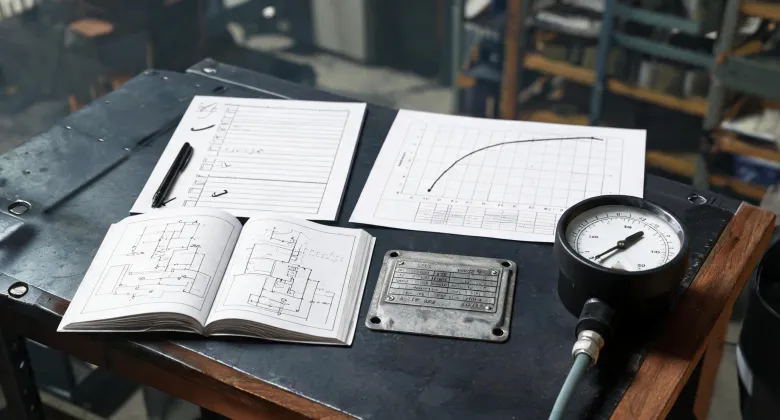
What I skipped was the dimension drawing in the Grundfos product selection tool. The one that shows the actual connection type, the flange bolt-hole spacing, the installation length. The one that tells you whether the thing will physically fit into the skid it's going into.
When it landed, it looked right. The model on the crate matched. The pump looked the way I expected. The customer signed for it and moved it to the shop floor.
Then it wouldn't bolt up.
I found out later — after a lot of finger-pointing — that the mismatch wasn't the pump's fault or the customer's fault. It was mine, because I read a summary document instead of the actual dimensional document for the specific variant. The summary said "approx." The drawing said the real number. My reading assumed those two were the same thing.
The Filters: Cheapest Unit Price, Most Expensive Order
The fuel filter line item had quietly gone sideways at the same time.
I'd pulled quotes from three filter suppliers and built a little spreadsheet of unit prices. The cheapest quote came in 22% below the most expensive. Easy call, I thought.
What I hadn't dug into was the MOQ, the lead time, and the freight structure. The cheapest quote had a 200-piece minimum, a 4-5 week lead time, and was quoted FOB, freight collect. The customer needed 24 units inside three weeks. So I ended up paying more per delivered unit than the mid-tier quote would have cost me anyway — because I got hit with a freight surcharge, a rush-handling fee, and I now have 176 fuel filters sitting in my warehouse that I'm slowly eating through.
That's the thing nobody puts on the filter wholesale cost guide: unit price is not cost. Unit price plus MOQ plus freight plus duty plus lead-time risk is cost.
The Spark Plugs: One Small Letter, One Big Problem
48 spark plugs. This was the "easy" line. I barely looked at it. The part number had a suffix letter I assumed was a packaging code.
It was the heat range code.
The customer installed them, the trucks fired up, and then started misfiring once they hit operating temperature. The technician assumed it was a fuel issue and chased it for two days before he pulled a plug and saw the electrodes.
Forty-six of the 48 came back scorched.
I've never fully understood why spark plug catalogs bury heat range in a suffix instead of putting it front and center. If someone out there knows the reason, I'd genuinely like to hear it. My best guess is that the numbering systems were built decades ago, before cross-referencing became the standard way people buy parts.
The Bill: $4,800 and a Lost Renewal
I ran every line of that order afterward, because I didn't want to make the same mistake twice.
- Pump connection rework and rush-shipped adapters: $1,120
- Expedited freight on the filters plus the dead stock I'm still carrying: $680
- Forty-six scrapped spark plugs: $390
- Customer's downtime — roughly $2,600 by their count — which we chose not to re-invoice, so effectively we ate it
Call it $4,800 all-in. For a 20-person procurement team, that's not a rounding error.
But the number that hurt worse wasn't on that list. The customer moved their next scheduled maintenance order to another supplier. That one I can't put a dollar figure on, but I felt it.
What We Changed
In July 2025 I wrote a 14-point pre-purchase check, one line for every mistake in that order. Three of them carry most of the weight:
- For pumps, always open the model-specific dimension drawing — never the generic spec sheet. Enter the full variant code into the Grundfos product selection tool and download the official document that shows the connection details and installation dimensions. The catalog page is for browsing. The drawing is for buying.
- Compare landed cost, not unit price. MOQ, freight, duty, packaging, storage, and lead-time risk, all loaded back onto the per-unit number. The cheapest quote on the spreadsheet is rarely the cheapest quote in reality.
- For spark plugs, verify heat range, thread, gap, and seat type — all four. Missing any one of them can put you back on the phone with a plant manager.
That checklist has caught something on roughly 30-plus orders since — a wrong suffix, a supplier whose "in stock" was actually sitting in a different warehouse two weeks away, a filter that had been quietly reformulated. I don't track the exact hit rate, but it's used more months than not.
If You're Getting Ready to Place an Order
If you've ever stood on a shop floor with the skid already torn apart and the wrong part in a box beside you, you know that feeling isn't bad luck. It's a skipped step.
Here's what you need to know: in B2B industrial supply, almost every "standard" label hides a document you have to open yourself. The industry is moving fast toward faster sourcing — online selection, instant quote comparisons, live stock checks — and that's genuinely good. Lead times that used to take days now take hours. But faster sourcing also means faster mistakes. A wrong click takes one second. A wrong part can cost you three days of somebody's shutdown.
This pricing and lead-time picture was accurate as of Q1 2026. Industrial pump and parts markets move quickly — product documentation gets revised, freight rates reset quarterly, and filter manufacturers change MOQs with little notice. Pull current written quotes and the latest official dimension drawing before you commit to anything.
The checklist is still taped to the wall next to my desk. The top line, in my own handwriting, says: open the drawing.

Rebecca Sloan
Rebecca Sloan is a power distribution and protection analyst specializing in circuit breakers, switchgear, contactors, fuses, surge protective devices, and coordination. She applies IEC 60947-2 breaker requirements, IEC 60269 fuse characteristics, and IEC 61643-11 tests while examining rated voltage, breaking capacity, time-current curves, selectivity, and prospective short-circuit current. She helps engineers and buyers compare protective devices against documented fault levels, installation conditions, maintenance access, and continuity priorities.